Showing posts with label Reading. Show all posts

Sunday, February 28, 2016

Reading Comprehension With Visualizing and Verbalizing

I have spent a lot of time working on teaching kids how to decode words and parse out how to say a word. But sometimes just being able to decode a word isn't enough. Some children need to be taught explicitly how to understand what they read, not just how to read it.

My Ana is one of those, mostly I think just because of her hearing disability and lack of language exposure early on. Many kids on the autism spectrum also require this sort of specific instruction in comprehension.

Anyone who does much research into the world of dyslexia and educational remediation of all sorts probably has come across the Lindamood Bell Centers. They are wonderful, effective, intense...

and extraordinarily expensive!

I called once before getting trained in Orton-Gillingham to see if they could help us with Ana. They quoted something like $20,000 for their 12-ish weeks (240 hours) of intensive tutoring over the summer. I think I about died when I heard that. Needless to say that was not an option for us, nor is it for most anyone else I know honestly!

Fortunately I was able to be trained in OG myself and that, plus Susan Barton's system has more than helped us to tackle the decoding aspect of reading. But I was still left with a child who struggled to comprehend things she read or heard. In fact, even describing a picture or a past event is difficult enough to induce tears!

Luckily, Lindamood Bell also has a system for comprehension called Visualizing and Verbalizing, and Gander Publishing sells a reasonably priced manual for it. Really all you need is the manual and some pictures to go with it, plus a few index cards and cardboard or felt colored squares.

I've been slowly reading through the Visualizing and Verbalizing manual these past few months and have begun the picture-to-picture stage with Ana. In this stage she describes a simple, colored picture to me and we work on going through each of 12 structure words to guide her description. Then I repeat her description back to her in my own words, describing the picture she made in my head through her description of the real picture that I cannot see.

The structure words are a fairly simple concept but I did find it useful to make up some extra notes on them. Especially because Ana not only needs to learn comprehension, she really needs to be taught enough vocabulary words to adequately describe an image.

I turned those notes into a printable for her benefit and I'm planning to laminate these and pin them around the schoolroom as study guides for her as she describes pictures or words. My notes go beyond what the manual describes, drawing connections to the part-of-speech each structure word points to, having a question for the student to ask themselves as they look at a picture or read, and listing whether it is a gross (large/main) or fine (small/less necessary) structure word. At the bottom are graphs or graphic organizers listing out many examples of words the student might use in describing a picture/word/sentence with that particular structure word.

This is an example of my basic notes for the first structure word:


You can find the entire printable in my store on Teachers Pay Teachers

Has anyone else used V/V at home? Did you find it fairly easy to DIY? Have you found any other great reading comprehension resources?

Monday, February 1, 2016

Marking Syllables Trick

This week has been extremely busy but I wanted to share this quick idea that has been working for me. Since I put all our student pages in protective sheets we use dry erase markers to mark syllables, but sometimes it wasn't as easy because the markers are slightly bigger and one of my students has Irlen's syndrome so it is hard for her to make her eyes focus on the separate syllables. I had seen syllable sliders recommended by Susan Barton but just didn't have it in the budget to get something like that for such a minor purpose. 

So, we started "highlighting" syllables with the dry erase markers instead. This way we can mark as many syllables as we like without any trouble and because it erases if my student realizes they divided it incorrectly the first time they can easily fix it. 

Plus, pretty colors!


Monday, January 25, 2016

Setting Up Barton Materials for each Level


I'm just now setting up our Barton Level 5 stuff and watching the tutor DVD's so I thought I'd show you how I set up all that Barton stuff! I'm a visual person and need everything very organized or I lose track of where we are so when I saw a discussion on a yahoo group about how to set up a binder for each level I immediately jumped on that idea!


I hope that is helpful to see it! It's a pretty simple setup, nothing complicated, but I know I had not thought to put the student pages in plastic sleeves like that until I saw it mentioned on a tutoring group! 

Soon I'll hopefully do another video or series of pictures showing the student binders I set up with the more consumable papers. 


Saturday, January 23, 2016

DIY Board Game


As we were chatting about in the comments of my last post about Barton 4, it's crucial to take time to review and practice skills as you go through Barton Reading and Spelling. 

When I first started my daughter in the program I didn't know about the fantastic Spelling Success games so I DIYed some basic games to help her practice. I still use these board games to take a break at the end of tutoring sessions and for fun review of words. 

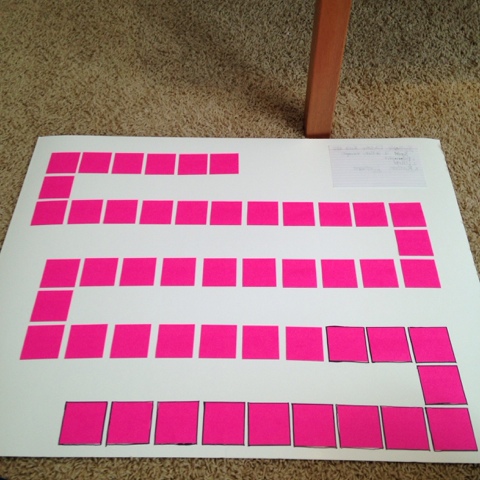
I wanted a large, colorful board game that would allow me to easily change out the words we were practicing so I could add more difficult words as we learned new concepts. 


First you'll need a large poster board, post-it notes, sharpies, and a large index card. You may also want washi-tape to add color or a pencil to trace things out before using the permanent sharpie. 

Pick a side to be your "Start" and leave room for a big "Start" square/picture. Lay out your post-it notes with a bit of room between.


Trace each post-it with a sharpie. This makes perfectly-sized squares that allow you to change out the post-its or move them around however you want but not need to re-make the entire board game.


Keep going! This time I decided to make a simple back and forth pattern. Be sure to leave enough space on the edge of the path so students don't get confused about where the next square they can hop to is.


And keep going! I traced each post-it after I had my path all laid out. I'd say making this game took 2 hours, including a break to nurse my six month old. 


Then add a start area! This game is going to be basketball themed because my newest student is a huge basketball fan. (I should have used the orange post-its but of course hindsight is 20/20)

I also traced a large index card at the top. I write each of our spelling rules on large index cards and so this way I can put the appropriate spelling rule at the top to remind the student as we play.


Last I added details to make it more fun! I bordered the spelling rule box with red washi-tape, added a basketball hoop as the finish line, and added arrows to make playing more random and interesting. I've learned that the more opportunities there are to be sent WAY back or WAY forward unexpectedly the more fun and the longer the game lasts. The rule with this game will be that if you land on a box with an arrow pointing out from it you have to go to the box the arrow points you to.

Simple, but effective.


Write a word on each post-it and your game is all ready to play! We play with colored, plastic counting bears and a dice. I've also used matchbox cars and lego guys to play!  As my student goes through the levels and learns new words I can replace these post-its with new ones to introduce new practice words.

Friday, January 22, 2016

Barton Level 4: Practice and Review (also...that darned shwa!!)


Anyone who has used Barton Reading and Spelling will tell you that Level 4 is a BEAST! Seriously, this is where the meat of the program starts. The first 3 levels are genius in how they set you up for success here and how they get kids learning fast. But Level 4? It has every rule you never knew you needed to know to read and spell perfectly. However, English is kinda a beast in and of itself and so the rules have exceptions and funny details and are just plain hard. Worth it....but hard. 

Both my daughter and my other oldest student are in Barton 4. Actually my daughter is "finished" but didn't totally ace the post-test so we're doing some review. Barton insists you should have a 95% accuracy or better to move on and I agree generally. So like with the other levels we're spending a little time at the end reviewing and playing games. 

My tutoring student was especially struggling with the BANANA rule and that darned schwa sound (the /uh/ in banana for all of you). Because the schwa rule is a rule of convenience vs logic (we use it to say words faster because basically we're all in a rush) and it's heavily dependent on where the accented and unaccented syllables are it is complicated to really get the hang of for some.

Anyway, so we went back through the lesson but with the 3 syllable types we've learned and a little accent symbol on post-its. So the kids would divide up a word with tiles, then label each syllable type and mark the vowel (see the cheat sheet for how to mark vowels over on the right?). After that they'd decide where the accent should go using a rubber band to determine which syllable is longest and using common sense/process of elimination. THEN they say the word again and we check to make sure they're right. 


Even for the ones where they got something incorrect it lead to great discussions about WHY it was wrong. It really seemed to help break up the concepts into manageable chunks.

We are ALL about the manageable chunks!

Does anyone else have any tips/tricks for Level 4??

Who the Heck Am I?


In case you're wondering who I am or what this blog is about, here's a picture of me....complete with falling-down-glasses, tiny nose ring, long earrings and braided hair. This is how I look 99% of the time, especially if you see me heading off to tutoring sessions. 

I'm a mom of 5 kids. One of whom is adopted. I'll let you guess who from the pictures! One of my children has diagnosed dyslexia (or: specific disability in reading) as well as several other minor special needs. I'm pretty sure my 5 year old also is dyslexic but it's too soon to tell for sure. 

Before having all these kids I was a teacher and that was okay but honestly I preferred teaching one-on-one. When I had my first kid I decided to stay home for a bit and now I'm still mostly a stay-at-home mom (and a homeschooling mom) but I also tutor 10+ hours a week. Which means I spend approximately 20 hours researching reading, prepping materials, keeping track of paperwork, and driving to my students and 10 hours actually sitting with them and teaching them. 

I take tutoring seriously because I've been there as a mom. When our adopted daughter came to us at 11 we were not told that she was completely illiterate. As in, she stumbled to try and read a basic baby board book and didn't realize road signs actually said something meaningful. I remember the day I realized she couldn't read and crying in my bedroom so she wouldn't see how upset I was. I remember the days knowing she needed help but not knowing what kind of help or who could give it to her. 

With few other options in our rural area I was blessed with the opportunity to get trained myself in Orton-Gillingham, the one research-based method for remediating dyslexia and other reading struggles. I learned a ton in my training! And I'm still learning every day through experience and talking to other moms and teachers and tutors. 

I'm not an expert. Not in the slightest. 

If you're looking for that then you should check out these guys or maybe this woman. 

All I'm here for is to share my experience. 

What's working, 

What's not working, 

What little tricks and tips I've found.

And *hopefully* lots of pictures and just regular old links and resources for you. 

And Who Are You? 

Well, I'm assuming you're a parent or educator or both and that your child or student or both is struggling to read. Or maybe you're just into researching reading methods for kicks? But my guess is the former ;) 

So if you find something here that helps please comment and let me know. If I say something totally wrong then please feel free to correct me. And if you have other ideas please please comment and share them with me and anyone else who stumbles on this site!